Another Use for AI
Recently I have decided to hire an assistant. It does not argue with me. It tells me the facts and admonishes me when I am wrong. The one I use does not matter as they are all capable of meeting my needs. Here is an example of how it is helping us.
In Amelia & Prince Edward counties of Virginia we have a cradle of a very large Lewellin clan. I tried thinking through the various dates and relationships but I knew I was confused. So I created this table, took a screen shot and attached it to an AI query.
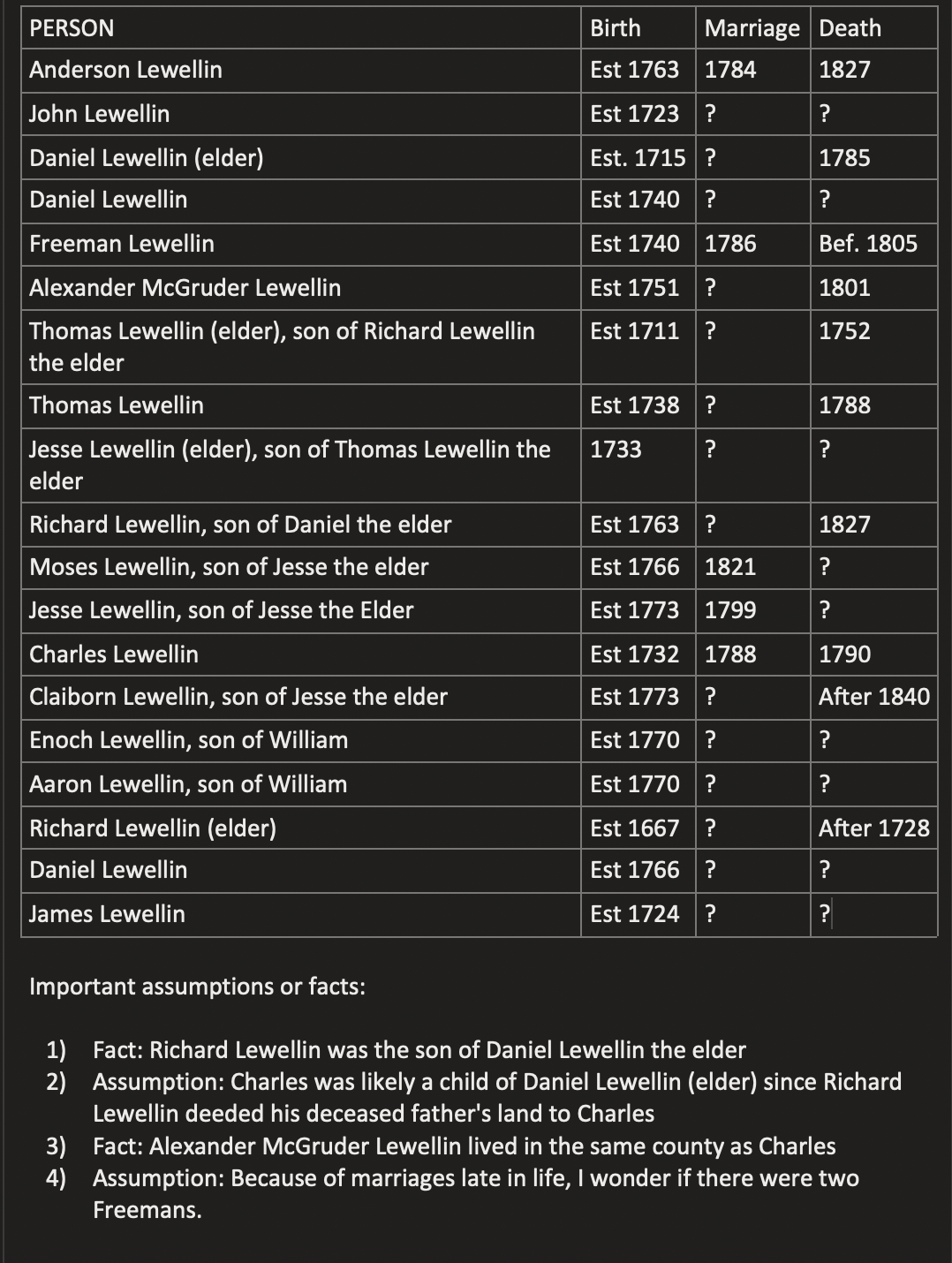
I fed this text into my AI chat prompt:
Knowing I am giving you insufficient information, use the attached information to resolve who might be the father of the persons, and who could not be the father of the person. Then give a brief genealogy of this clan:
To which AI responded:
Chronological assessment of possible fathers (based solely on the birth estimates and stated facts in the table)
Birth years are estimates, so relationships are possible only when the putative father is at least ~16–18 years older than the child and is still living at the child’s birth. Anything tighter is chronologically impossible.
Who can be ruled out as father of whom
- Richard Lewellin (elder) (est. 1667) can be the father of the earliest generation (Thomas elder est. 1711, Daniel elder est. 1715, John est. 1723, James est. 1724). He cannot be the father of anyone born after about 1710–1715.
- Thomas Lewellin (elder) (est. 1711, d. 1752) can be the father of Jesse (elder) (1733) and of Thomas (est. 1738). He cannot be the father of anyone born after 1752.
- Daniel Lewellin (elder) (est. 1715, d. 1785) can be the father of Daniel (est. 1740), Freeman (est. 1740), Charles (est. 1732), Alexander McGruder (est. 1751), and Richard (est. 1763). He cannot be the father of Anderson (est. 1763) if Anderson’s birth is firm, nor of anyone born after 1785.
- Jesse Lewellin (elder) (1733) can be the father of Moses (est. 1766), Jesse Jr. (est. 1773), and Claiborn (est. 1773). He cannot be the father of the earlier men.
- Charles Lewellin (est. 1732, d. 1790) can be the father of Anderson (est. 1763) and of Richard (est. 1763) only if the land-deed assumption holds and the birth estimates flex slightly. He cannot be the father of the men born in the 1710s–1740s.
- No man in the table born after ~1750 can be the father of Anderson, Richard (son of Daniel), Moses, or the 1770s cohort.
Possible structure consistent with the given facts and dates
Generation 1
Richard Lewellin (elder) (est. 1667–after 1728)
Generation 2 (sons of Richard elder)
- Thomas Lewellin (elder) (est. 1711–1752)
- Daniel Lewellin (elder) (est. 1715–1785)
- John Lewellin (est. 1723)
- James Lewellin (est. 1724)
Generation 3
- Jesse Lewellin (elder) (1733), son of Thomas (elder)
- Thomas Lewellin (est. 1738–1788), son of Thomas (elder)
- Daniel Lewellin (est. 1740), son of Daniel (elder)
- Freeman Lewellin (est. 1740–bef. 1805), son of Daniel (elder)
- Charles Lewellin (est. 1732–1790), possible son of Daniel (elder) (per the land-deed assumption)
- Alexander McGruder Lewellin (est. 1751–1801), same county as Charles
Generation 4
- Richard Lewellin (est. 1763–1827), son of Daniel (elder)
- Anderson Lewellin (est. 1763–1827), possible son of Charles
- Moses Lewellin (est. 1766), son of Jesse (elder)
- Jesse Lewellin (est. 1773), son of Jesse (elder)
- Claiborn Lewellin (est. 1773–after 1840), son of Jesse (elder)
- Enoch and Aaron Lewellin (est. 1770), sons of a William (William himself is not in the table)
Brief genealogy of the clan (as far as the table supports)
Richard Lewellin (elder) heads the group. His sons include Thomas (elder) and Daniel (elder). Thomas (elder) is the father of Jesse (elder). Daniel (elder) is the father of Richard (est. 1763) and, on the stated assumption, possibly of Charles. Jesse (elder) is the father of Moses, Jesse Jr., and Claiborn. Anderson (est. 1763) and Alexander McGruder sit in the same generation as Richard (son of Daniel); Anderson may belong to Charles. The late-marrying Freeman and the second Daniel remain less securely placed. The table supplies no further downward links and no wives except the bare marriage years listed.
This is the maximum structure the supplied dates and the four stated facts/assumptions will bear. Additional deeds, wills, or tax lists would be required to confirm or reject any of the possible links.
In a sense this is classic garbage in and garbage out. On the other hand, when you are stuck or cannot comprehend all you need to consider, this approach can eliminate the impossible and suggest the probable.